

everything you need for better leaders and smarter strategies
Monthly newsletters, complimentary articles, and free assessments — we believe the power of psychology and behavioral science should be accessible to everyone. If you like what you see, consider scheduling an introductory call to discuss how to bring this work to you and your teams.
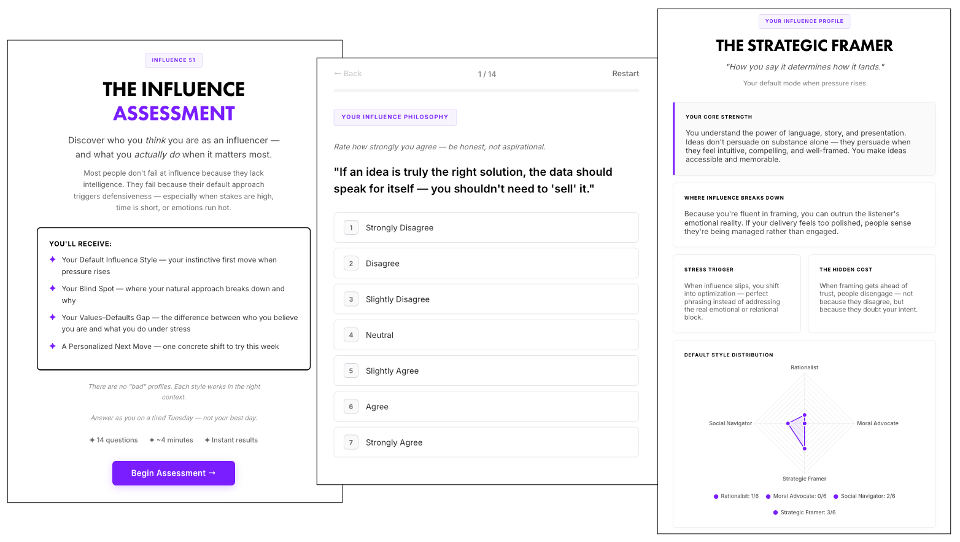
DISCOVER YOUR INFLUENCE STYLE
Take our Influence Assessment to determine your influence tendencies, advantages, and opportunities for improvement.
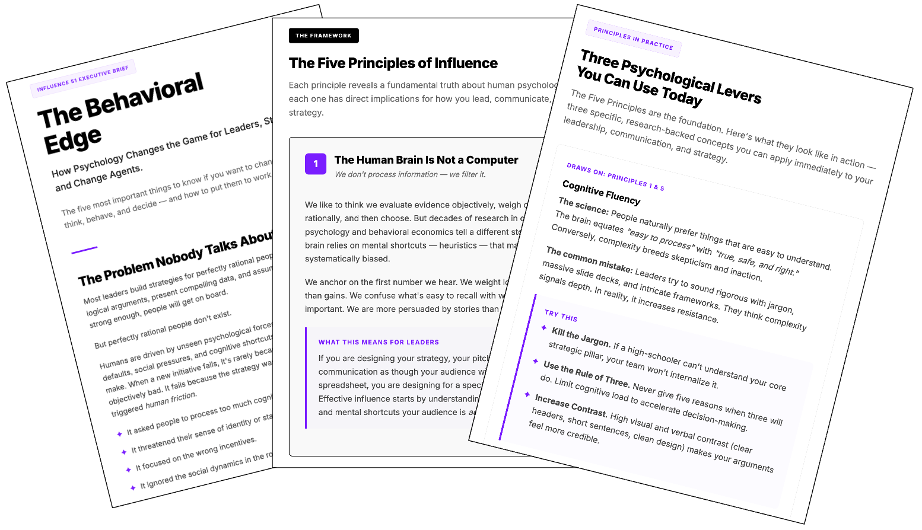
DOWNLOAD OUR FREE GUIDE FOR LEADERS
For those looking for an accessible introduction to behavioral psychology and how to use it to improve your effectiveness, download our free executive brief.
april 2026 nEWSLETTER
In a world where all conventional wisdom suggests that designers aim to “remove friction,” could adding a bit of friction actually increase engagement and commitment?
For at least the past two decades or so, website, product, and user experience (UX) designers have essentially had a consensus on how to increase the likelihood that users and/or consumers will perform a desired behavior (e.g., buying a product, registering for a workshop, etc.): remove (or at least significantly reduce) any friction related to the desired behavior. In other words, make the experience (and, critically, the actions required to achieve it) as effortless as possible.
Enable one-click purchases.
Minimize the number of fields on a submission form.
Ensure sign-ups are fast and seamless.
The logic underlying these design philosophies is fairly sound. By in large, humans are predisposed to be quite lazy. For instance, we have research to show that if you add even a single step to a check-out or sign-up process, the number of people completing the process drops dramatically. So if your sole goal is to increase participation or clicks, minimizing any and all friction is probably the route with the greatest return on investment.
But what if you care about more than just clicks? What if you - like many leaders and companies - are trying to build cohorts and communities that are actually engaged and committed (not just “signed up”)? Is a “frictionless” experience still the best way to go?
Recent research suggests that it might not be. But before we delve into that, we need to take a trip all the way back to the late-1950s.
In 1959, Elliot Aronson and his colleagues conducted a study on group initiation. They told young women that they would be joining a group discussion on the psychology of sex. Unbeknownst to the young women, they were randomly divided into three conditions:
A control condition (where they were permitted to join the discussion without any type of “initiation”)
A “mild” initiation condition (where they were made to read aloud sexual but non-embarrassing words like “prostitute” and “virgin” before they were permitted to join the group for discussion)
A “severe” initiation condition (where they were made to read aloud 12 obscene words and two highly-sexual passages from novels before they were allowed to join)
Given the generational context (i.e., an era where it was considered quite scandalous - and likely a bit anxiety-inducing - to be a woman uttering such lewd phrases in public), naturally, engaging in the mild (and especially the “severe”) initiations created a good deal of discomfort for the participants…which was precisely the point. Aronson and colleagues wanted to see if the difference in the “effort” they put forth to join the group would impact how they came to value their membership within in.
Despite the fact that, after the “initiations,” the group discussions were all objectively the same across all conditions (something the researchers made sure to control), the women who endured severe embarrassment rated the discussion as being significantly more interesting, engaging, and worthwhile (97.6 out of 100) than the women who endured the mild discomfort (81.8) or the control group (80.2). They didn't rate it higher because it was better (it wasn’t - it was exactly the same) - they rated it higher because they needed to justify the effort they had put forth to join.
This phenomenon, known as "effort justification," reveals something fundamental about human psychology: when we invest effort into something, we unconsciously rationalize that investment by increasing our perceived value of and commitment to that action. The psychological logic is straightforward: "If I spent time and energy on this, it must be worth my time."
Now let’s fast forward to 2023. Researchers Dykstra, O'Flaherty, and Whillans set out to test a counter-intuitive hypothesis: Could adding modest friction at sign-up actually increase long-term engagement?
They conducted a large-scale field experiment involving over 27,000 participants who were enrolling in a carpooling program (an ideal scenario because they could measure both sign-up rates and actual behavior; i.e., carpool trips taken).
The research team randomly varied the sign-up process for the participants: some experienced a simple, streamlined enrollment while others were required to invest more effort to participate in the same exact program (e.g., more steps, additional information, etc.). The goal was to observe how this initial friction that was added to the experience of the second group would impact not only the initial sign-up rates but, critically, the participants' subsequent engagement with (i.e., active use of) the carpooling service.
As expected, the results showed that a more drawn-out registration process reduced the sign-up rate (with the second group exhibiting a 25 percentage point drop in registrations compared to the first group). But here’s where things get interesting: those that did sign up in the second, more effortful registration group took 1.6 times more carpool trips compared to their counterparts in the low-effort group.
That’s a huge difference.
So why does this happen? Why did people who were forced to work a little harder end up becoming more inclined to actually use the service? It’s a phenomenon known as the “buy-in effect.”
Essentially, a modest initial "investment" (of time or effort) can both filter and actually produce more genuinely committed users. It creates a psychological "buy-in," where individuals feel a stronger sense of ownership and dedication to the behavior to which they've just committed.
There are three psychological mechanisms underlying the buy-in effect:
Effort Justification: As we saw with Aronson's 1959 study, when people invest effort, they unconsciously rationalize that effort by increasing their perceived value of the outcome. Users who complete a detailed onboarding process inherently believe the product or service is more valuable than those who skipped it.
Self-Selection: Higher initial friction naturally filters out casual browsers and uncommitted participants. The people who do complete a more involved enrollment are, by the very fact that they were willing to do it, inherently more motivated and interested.
The Endowment Effect: When people invest effort in creating something (a customized profile, stated goals, detailed preferences, etc.), they develop a sense of “psychological ownership” over that thing. They feel the experience is "theirs," dramatically increasing their likelihood of continued engagement.
The buy-in effect teaches us an important lesson: simpler isn't always better. Optimizing purely for high acquisition rates by minimizing all friction might lead to a larger user base, but also a less engaged one. So while "easy" is often good, "effortful" can sometimes be better, especially when it comes to fostering genuine commitment. By asking users to invest just a bit of effort upfront, you're able to secure more than just their sign-up - you're able to secure their buy-in. A strategically applied touch of purposeful friction can cultivate a slightly smaller (but far more engaged, retained, and loyal) user base.
applying THE INSIGHT
Step 1: Audit Your Baseline
Before you start tinkering with your onboarding or enrollment processes, you need a clear picture of your current reality. What are your metrics truly telling you?
Go Beyond the Surface: Don't just look at how many people click "Sign Up." Dig deeper. What percentage of those sign-ups actually complete the next critical step? How many become active users within 7 days, 30 days, or even 90 days?
Track the Drop-Offs: Pinpoint where users are currently abandoning your process. Is it a specific form field? A mandatory survey? Knowing these points helps you understand what existing friction (both good and bad) is already at play.
The Inactive User Cost: Are you "paying" for inactive users? This could be in the form of database storage, email marketing to uninterested leads, or even just bandwidth. Understanding this cost can highlight the value of fewer, more engaged users.
The Engagement Ratio: Calculate your ratio of active users to total registered users. If this ratio is low (e.g., less than 20-30% of sign-ups are genuinely active), you have a significant opportunity to improve.
Your Action: Gather the data. If your engagement rates are lagging despite high sign-up numbers, the buy-in effect is likely an experiment worth running. You need to understand the "before" picture to truly appreciate how to achieve the "after."
Step 2: Identify Meaningful Friction
This is the strategic heart of applying the buy-in effect. Not all friction is created equal. The goal isn't to make things harder just for the sake of it, but to make any added effort more purposeful.
When evaluating potential friction points, ask yourself if they tick these boxes:
Relevant to Core Value: Does this step directly relate to why someone is here? Does it help them clarify their own intentions or deepen their understanding of what your product or service offers?
Good Example: A fitness app asking, "What are your top 3 fitness goals for the next 90 days?" (Relevant to their health journey)
Bad Example: A fitness app asking, "What's your favorite color?" (Irrelevant to fitness)
Personalizing the Experience: Does this step allow users to tailor the experience to their needs, making it feel uniquely theirs from the start?
Good Example: An online learning platform letting you select specific topics of interest to customize your curriculum feed.
Bad Example: Forcing you to answer generic demographic questions that don't visibly impact the experience.
Commitment-Revealing: Does this step ask the user to articulate or demonstrate a small but significant commitment to their own success within your platform?
Good Example: An employee wellness program requiring you to write a brief personal goal statement for the challenge.
Bad Example: Making you verify your identity with three different forms of ID for a low-stakes program.
Ownership-Building: Does this step make the user feel like they're actively building or creating something within your system, fostering a sense of psychological ownership?
Good Example: A project management tool asking you to set up your very first project template during onboarding.
Bad Example: Presenting a long, static "terms and conditions" page you just click through.
Your Action: Brainstorm 1-2 specific, meaningful friction points you could introduce into your process. Focus on quality over quantity. However, avoid arbitrary friction at all costs! This includes hurdles that serve no purpose, offer no personalization, or feel like busywork. Think unnecessary CAPTCHA tests, redundant form fields, or security questions that create friction without providing any clear benefit to the user's experience. Such friction only leads to frustration and abandonment.
Step 3: A/B Test Rigorously
The buy-in effect is counter-intuitive, which means you can't rely on gut feelings. You need objective data to prove its effectiveness for your specific audience and product. This is where A/B testing becomes your best friend.
Design Your Experiment:
Control Group: Users who experience your current onboarding/enrollment process.
Treatment Group: Users who go through an identical process, but with the (sole!) addition of your chosen meaningful friction points (e.g., one extra question about their goals, a brief personalization step).
Measure the Right Things: While you'll certainly track initial sign-up rates (and yes, they will likely drop), your focus must shift to post-enrollment behaviors:
7-Day Active Rate: What percentage of users in each group actually use your service within the first week?
30-Day Retention: How many are still active a month later?
Engagement Depth: Are they using more features? Spending more time? Completing more key actions?
Customer Lifetime Value (CLTV): For monetized products, how do the long-term economics compare between groups?
Don't Stop Early: Resist the urge to cancel the test if you see an initial dip in sign-ups. The magic of the buy-in effect happens after enrollment. Run your tests for a substantial period (e.g., 60-90 days) to allow real user behavior patterns and retention to emerge.
Your Action: Set up a clear A/B test with precise definitions for your control and treatment groups, and commit to measuring long-term engagement metrics, not just initial conversions.
Some Examples of Strategic Applications
Product Onboarding: Instead of frictionless sign-ups, ask users to set goals, customize preferences, or define needs.
Example: A project management tool asks users to set up their first project template.
Membership & Subscription Programs: Require a brief goal-setting exercise or preference selection during enrollment.
Example: A language learning app asks users to articulate why they want to learn.
Employee Engagement & Training: Ask participants to write a personal commitment statement or set measurable objectives before joining.
Example: A company wellness challenge requires employees to define their specific health goals.
Customer Loyalty Programs: Involve members in customizing rewards or selecting preferences during activation.
Example: A loyalty program prompts members to select their preferred product categories.
WHAT I’M CURRENTLY READING
The Moral Animal by Robert Wright
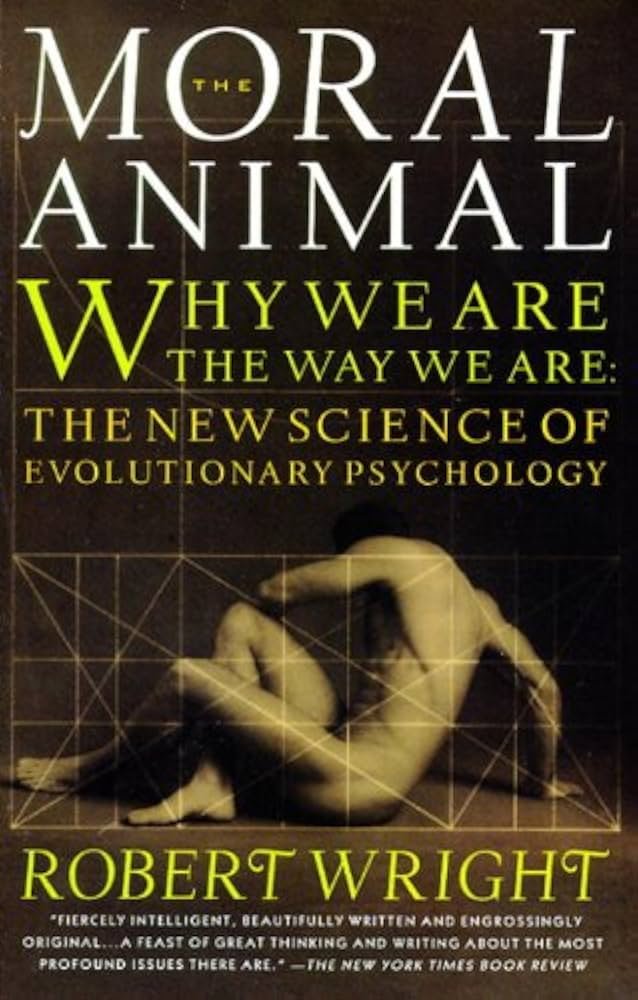
Lately, I've been revisiting Robert Wright's book, "The Moral Animal: Why We Are the Way We Are". If you're fascinated by the deeper, often uncomfortable, truths behind human behavior - especially how and why we are inclined to rationalize our actions - then this book is a very compelling option.
Wright’s central premise is that our most profound moral intuitions - our capacity for love, our sense of justice, and even our capacity for self-deception - aren't transcendent or purely cultural constructs; they are, at their core, products of evolution by natural selection.
What makes "The Moral Animal" so compelling is how it challenges our conventional, often romanticized, notions of morality. Wright argues that we didn't evolve to understand morality "correctly," but rather to behave in ways that promoted our ancestors' reproductive success. This means many of our seemingly altruistic acts are rooted in subtle forms of self-interest, status-seeking, or the deeply ingrained desire for reciprocal relationships. He demonstrates how our minds are wired for profound self-deception, allowing us to genuinely believe we're acting from noble motives even when unconscious evolutionary imperatives are pulling the strings.
What makes this book useful for practitioners is that Wright goes beyond the "everything is selfish" reductionism. Instead, he explores how our evolved moral machinery often misfires in modern contexts. We developed moral intuitions for small tribal groups where relationships were face-to-face and consequences were immediate. But we now live in societies of millions, with anonymous interactions and delayed/diffuse consequences. The result? We're shockingly bad at moral reasoning about systemic issues, large-scale harm, and impersonal transactions - even as we're intensely moved by individual stories. We punish individuals harshly for minor offenses but tolerate enormous institutional harm. We care deeply about our in-group but remain indifferent to distant suffering.
If you work in product design, organizational behavior, marketing, or anywhere that involves understanding human thinking and decision-making, this book will reframe how you think about motivation, persuasion, and behavioral change. It explains why people aren't nearly as rational as they think they are, why they're remarkably skilled at self-deception, and why the moral justifications they give for their behavior often conceal the actual drivers. Just as the "buy-in effect" reveals the hidden drivers behind engagement, "The Moral Animal" peels back layers to expose the ancient algorithms shaping our ethics, our relationships, and our very sense of self. It's a challenging, occasionally unsettling, but ultimately illuminating read that forces you to rethink not just human nature, but the very foundations of your own moral compass. It's the kind of book that makes you simultaneously more skeptical of grand moral claims and more compassionate about human limitations.
sign up for the influence 51 newsletter
Monthly insights into the factors that move people. New subscribers also get complimentary enrollment into our 5-day email course centered around “The Five Principles of Influence.”
enjoy our complimentary articles
Loss Aversion

Nudging and Choice Architecture

Empathy and Its Limitations

Message Framing

Conformity and Groupthink

Political Disagreement

Cognitive Dissonance

Pricing Psychology

Prosocial Behavior

Social Pain

Subconscious Influence

How Political Dispositions Form

